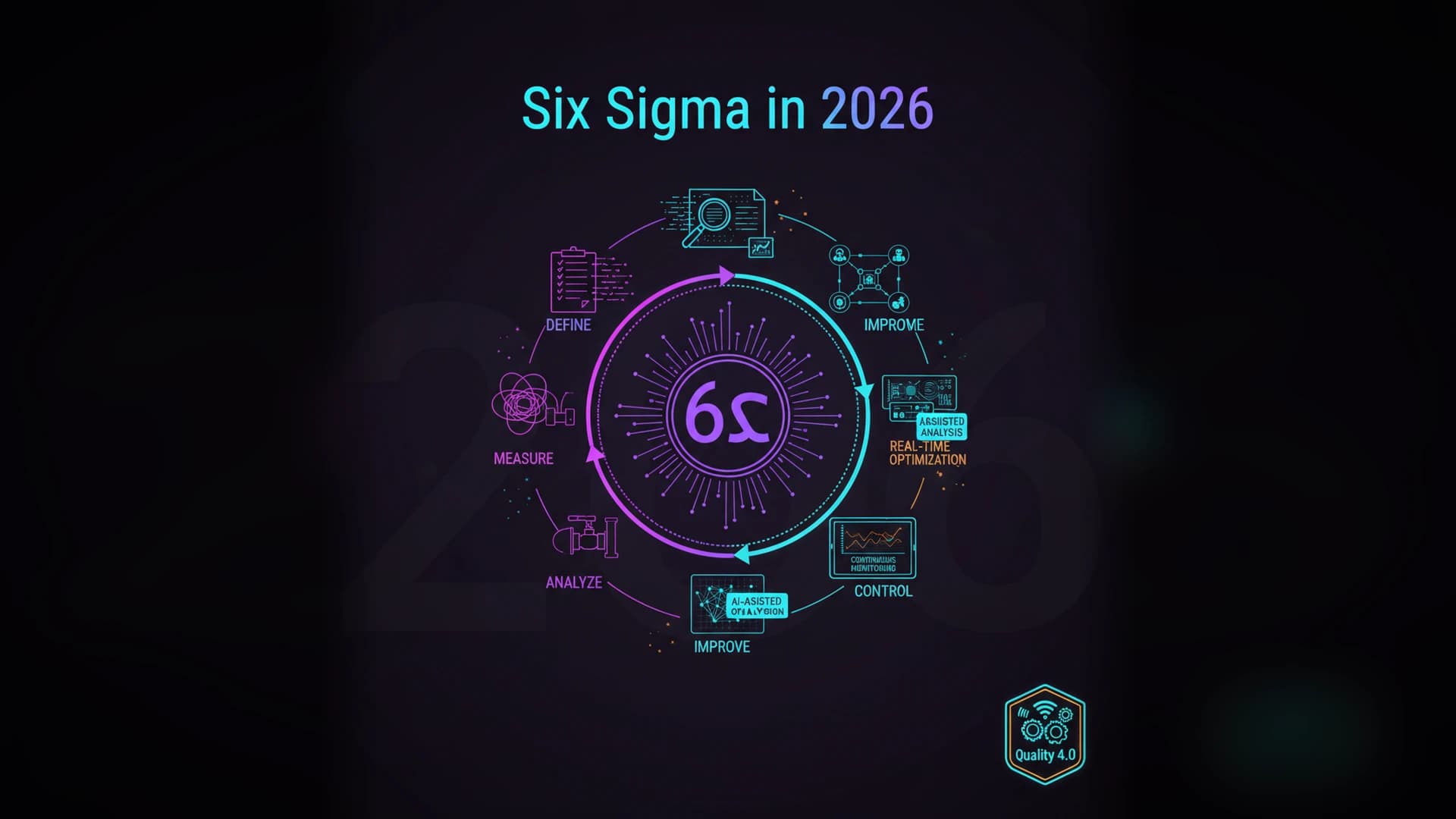
Six Sigma was built for an era of slide rules, manual data collection, and the assumption that everything is normally distributed. Two of those three are gone. The third should be.
The core insight — reduce variation to reduce defects — is as valid in 2026 as it was in 1986. Variation still costs money. Process capability still matters. Statistical rigor still separates guessing from knowing. None of that has changed.
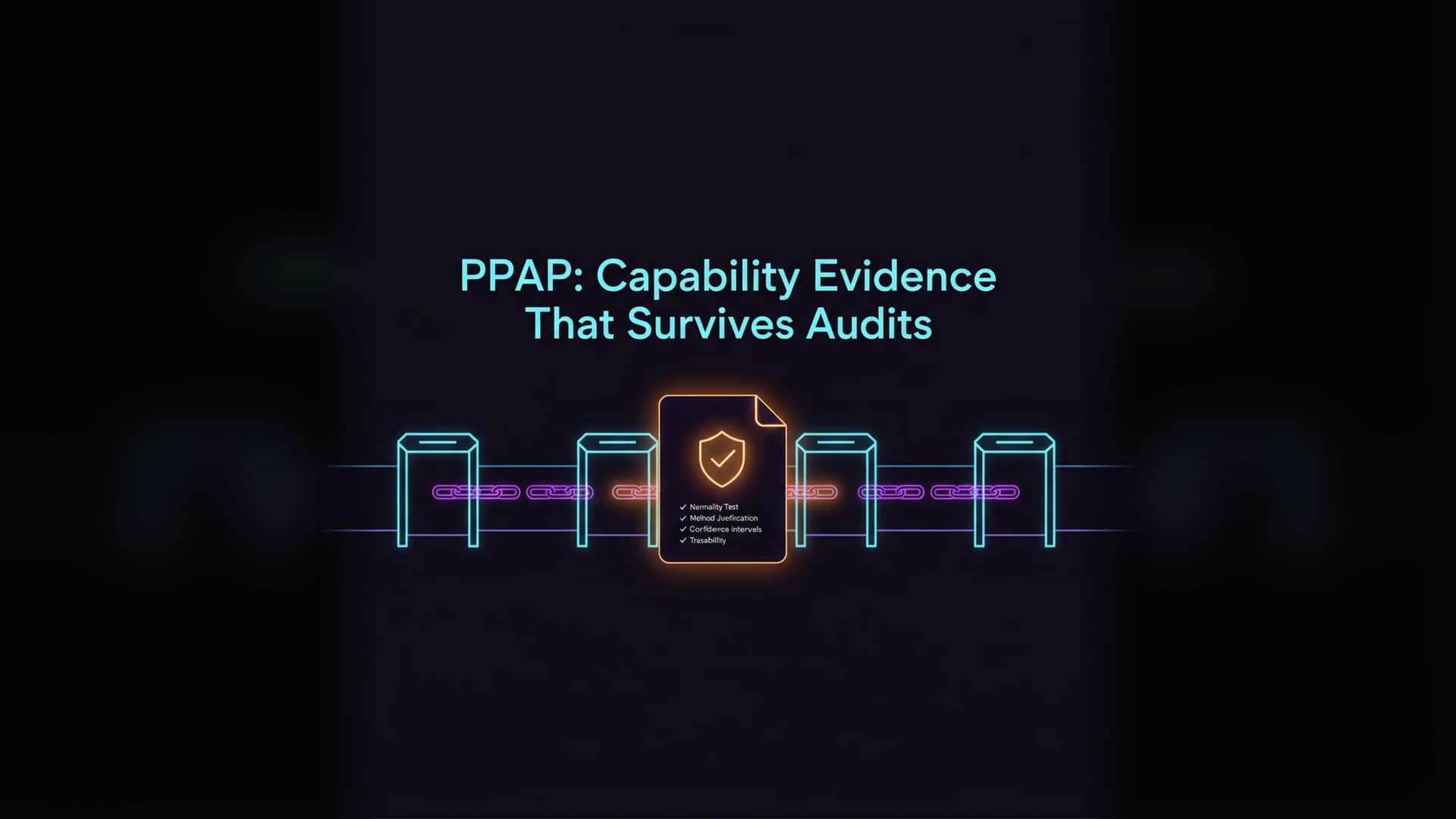
Your PPAP got rejected — not for bad parts, but for bad statistics. OEM auditors now scrutinize whether your Cpk method matches your data. Build a PPAP capability evidence chain that withstands the toughest audits.
What has changed is everything around it: how data is collected, how fast decisions need to happen, and what statistical methods are available. Six Sigma practitioners who update their toolkit will find the methodology more powerful than ever. Those who don't will find themselves solving 2026 problems with 1986 tools.
What Still Works
The DMAIC Discipline
Define, Measure, Analyze, Improve, Control. The five-phase structure forces systematic problem-solving instead of firefighting. That discipline has nothing to do with statistics — it's project management applied to quality. It works.
What's outdated isn't DMAIC itself but the rigid, months-long project cycles it often implies. Modern quality problems need faster iteration. DMAIC as a mental framework (define the problem before solving it, measure before improving) is timeless. DMAIC as a 6-month project with toll-gate reviews and belt certifications is increasingly mismatched with production tempo.
Variation as the Enemy
The fundamental Six Sigma insight: defects come from variation, not from the mean. Reduce σ and defects fall exponentially. This is a mathematical fact, not a methodology opinion. It was true in 1986 and will be true in 2086.
Where this gets tricky is when "reduce σ" becomes "estimate σ and compute Cpk" — because the estimation assumes normality, and most manufacturing data isn't normal. The insight (variation drives defects) is correct. The specific implementation (3σ limits from a Gaussian model) often isn't.
Measurement System Analysis
MSA — particularly Gage R&R — is a Six Sigma contribution that manufacturing can't afford to lose. Before you improve a process, verify that your measurement system can see the improvement. Before you compute process capability, verify that the variation you're measuring is process variation, not gage noise.
This practice predates the methodology but was popularized and standardized through it. It remains essential regardless of what statistical methods evolve.
What's Outdated
The Normality Default
Six Sigma teaches Cpk = (USL - μ) / 3σ as the core capability metric. The formula assumes Gaussian data. The training rarely emphasizes this assumption or what happens when it fails.
For 60–80% of manufacturing datasets, it fails. The resulting Cpk is wrong — sometimes optimistic, sometimes pessimistic, always unquantifiably so. Six Sigma's statistical foundation was built on an assumption that doesn't hold for most of the data it analyzes.
Modern methods — entropy-based, nonparametric, distribution-free — compute capability without this assumption. They give the same answer as traditional Cpk when data is normal, and a correct answer when it isn't. Updating the Six Sigma toolkit to include these methods doesn't break the methodology — it fixes its biggest blind spot.
Manual Data Collection and Analysis
The classic approach assumes data is collected manually, entered into spreadsheets, and analyzed in desktop software. The data arrives in batches — a capability study here, a control chart there.
Data-driven manufacturing in 2026 produces continuous data streams. IIoT sensors generate measurements every second. MES systems log parameters in real time. The data doesn't arrive in batches — it flows.
The traditional tools — Pareto charts, cause-and-effect diagrams, hypothesis tests — were designed for batch analysis. They work on snapshots. Continuous data needs continuous analysis: real-time monitoring, automated drift detection, adaptive control limits. The tools exist. They're just not in the training binder.
Belt Certification as Proxy for Competence
Green Belt, Black Belt, Master Black Belt — the certification hierarchy was designed to ensure methodological rigor. In practice, it created a gatekeeping system where statistical analysis is delegated to certified specialists instead of embedded in daily operations.
In an era of automated analytics, the bottleneck isn't statistical expertise — it's data access and tool adoption. A quality engineer who can upload data to a modern analytics tool and interpret the results is more effective than a Black Belt who runs the same analyses manually in Minitab.
Certifications measure training completion, not analytical capability. The industry is slowly recognizing this.
What's New Since Six Sigma
Quality 4.0
Quality 4.0 applies Industry 4.0 concepts — connectivity, automation, AI — to quality management. Real-time SPC, automated inspection, predictive quality, digital twins.
Quality 4.0 doesn't replace Six Sigma. It provides the data infrastructure that makes its statistical tools more powerful. When every part is measured (not sampled), when data flows continuously (not in batches), when analysis is automated (not manual), the Six Sigma question — "is this process capable?" — can be answered in real time instead of quarterly.
The gap: Quality 4.0 has the data. It often uses the same statistical methods Six Sigma always used — including the normality assumption. More data with the wrong method is still wrong, just faster.
Distribution-Free Capability
The biggest methodological advancement since Six Sigma's founding: capability analysis that doesn't assume a distribution. The EGDF approach produces Cpk without normality, Weibull, lognormal, or any other distributional assumption.
This solves the fundamental statistical weakness in Six Sigma's toolkit. The methodology says "reduce variation." The original tools say "measure variation assuming a bell curve." Distribution-free methods say "measure variation from whatever shape the data has."
Same goal. More honest math. That's an upgrade, not a replacement.
AI-Assisted Root Cause Analysis
The Analyze phase traditionally depends on fishbone diagrams, 5-why analysis, and hypothesis testing guided by expert judgment. AI and machine learning add pattern recognition across thousands of process variables simultaneously.
These tools don't replace the Black Belt's process knowledge. They augment it — surfacing correlations and interactions that a human analyzing spreadsheets would miss. The practitioner who combines domain expertise with AI-assisted analysis has a substantial advantage over either approach alone.
Six Sigma's namesake — 3.4 DPMO, the "six sigma" target — was aspirational in 1986. In 2026, many manufacturing processes achieve it for individual characteristics. The target was always about the journey (systematic variation reduction) more than the destination (3.4 DPMO).
What matters now isn't the sigma level label but the honesty of the underlying measurement. A process reported at "4 sigma" using normal-based Cpk on skewed data is lying about its actual defect rate. A process at "3.5 sigma" using distribution-free methods is telling the truth.
Honest measurement at a lower sigma level is more valuable than inflated measurement at a higher one. The methodology's own principles demand this — the methodology that insists on data-driven decisions should insist on correct data.
Bridging Old and New
Six Sigma in 2026 isn't dead. It's incomplete.
The discipline — systematic problem-solving, data over opinion, variation as the enemy — is permanent. The specific tools need updating. Replace the normality default with distribution-free methods. Replace batch analysis with continuous monitoring. Replace statistical process control snapshots with real-time capability tracking.
Keep the DMAIC framework. Keep the MSA discipline. Keep the relentless focus on variation. Update the statistics that measure it.
See what Six Sigma metrics look like with distribution-free analysis — honest Cpk, real defect probabilities, no normality assumption. Analyze your data free →
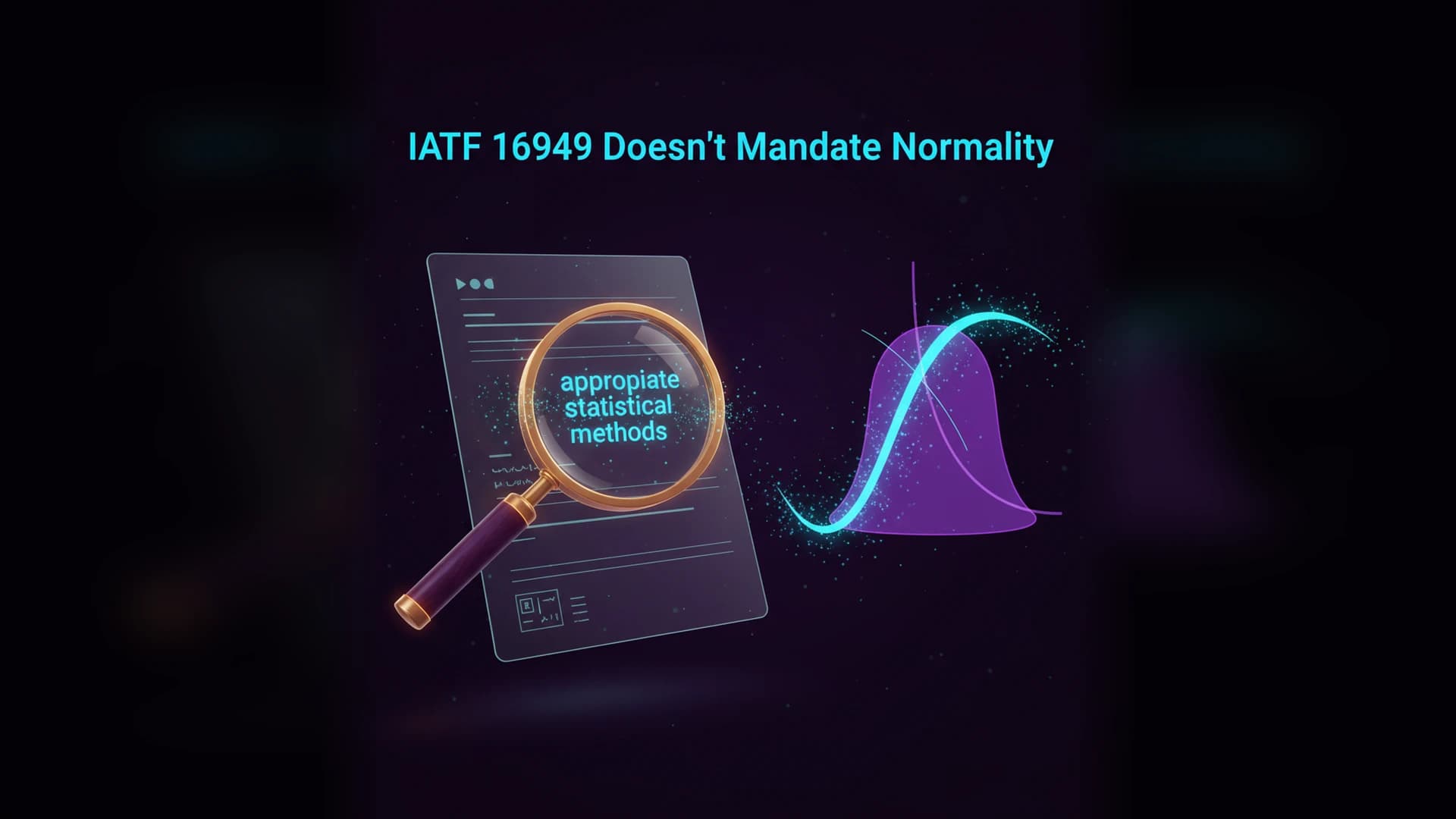
IATF 16949 requires “appropriate statistical methods” — not normal-based Cpk. For the 60–80% of datasets that fail normality tests, the standard actually supports distribution-free methods like entropy-based analysis.