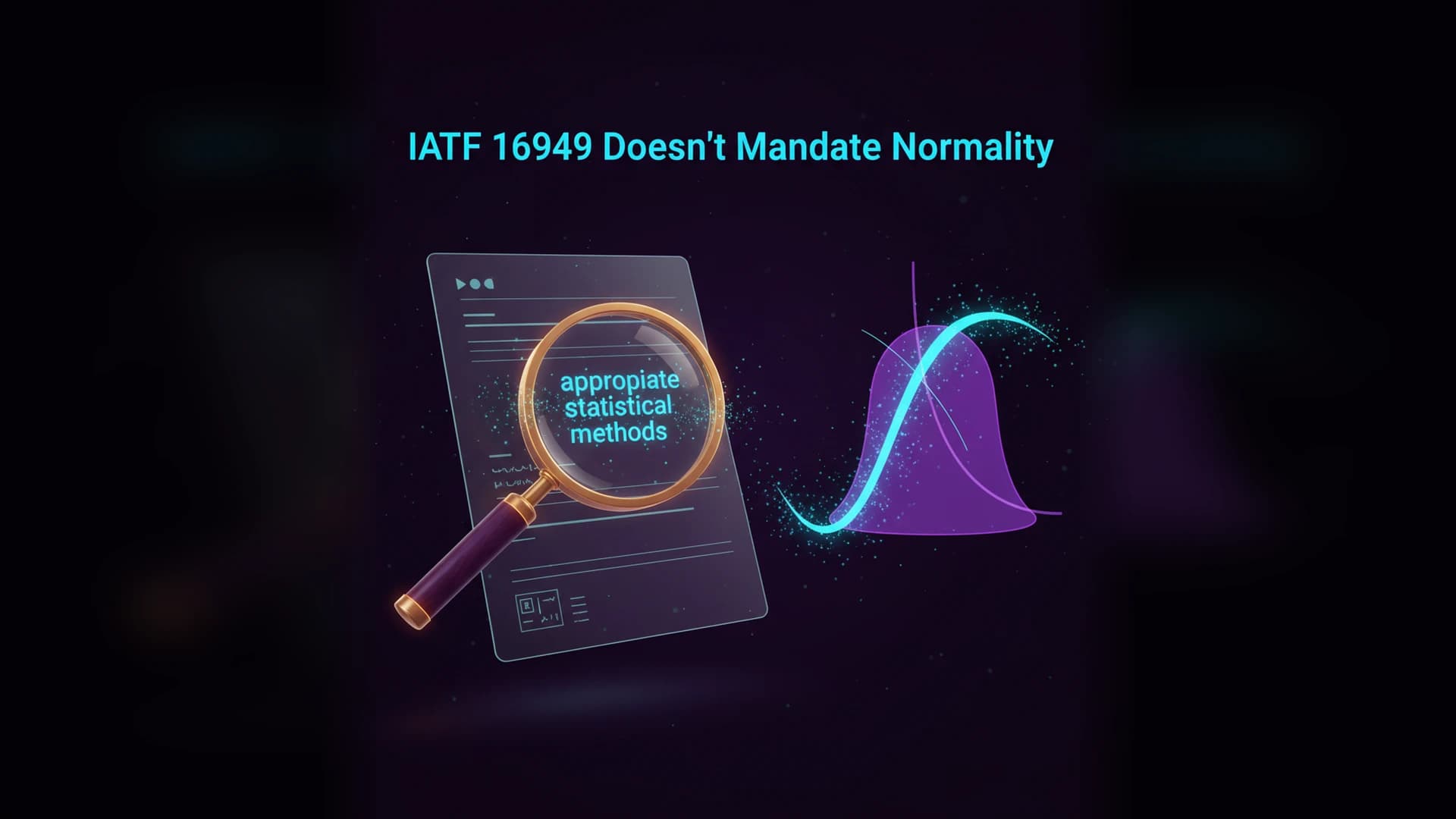
That's the question to ask the next time someone tells you "IATF 16949 requires normal-distribution-based Cpk." Because the clause doesn't exist. The standard requires "appropriate statistical methods." Not normal-based. Not parametric. Appropriate.
For 60–80% of industrial datasets — the ones that fail normality tests — normal-based Cpk is not the appropriate method. It's the wrong method. And the standard you're citing to justify it actually says so.
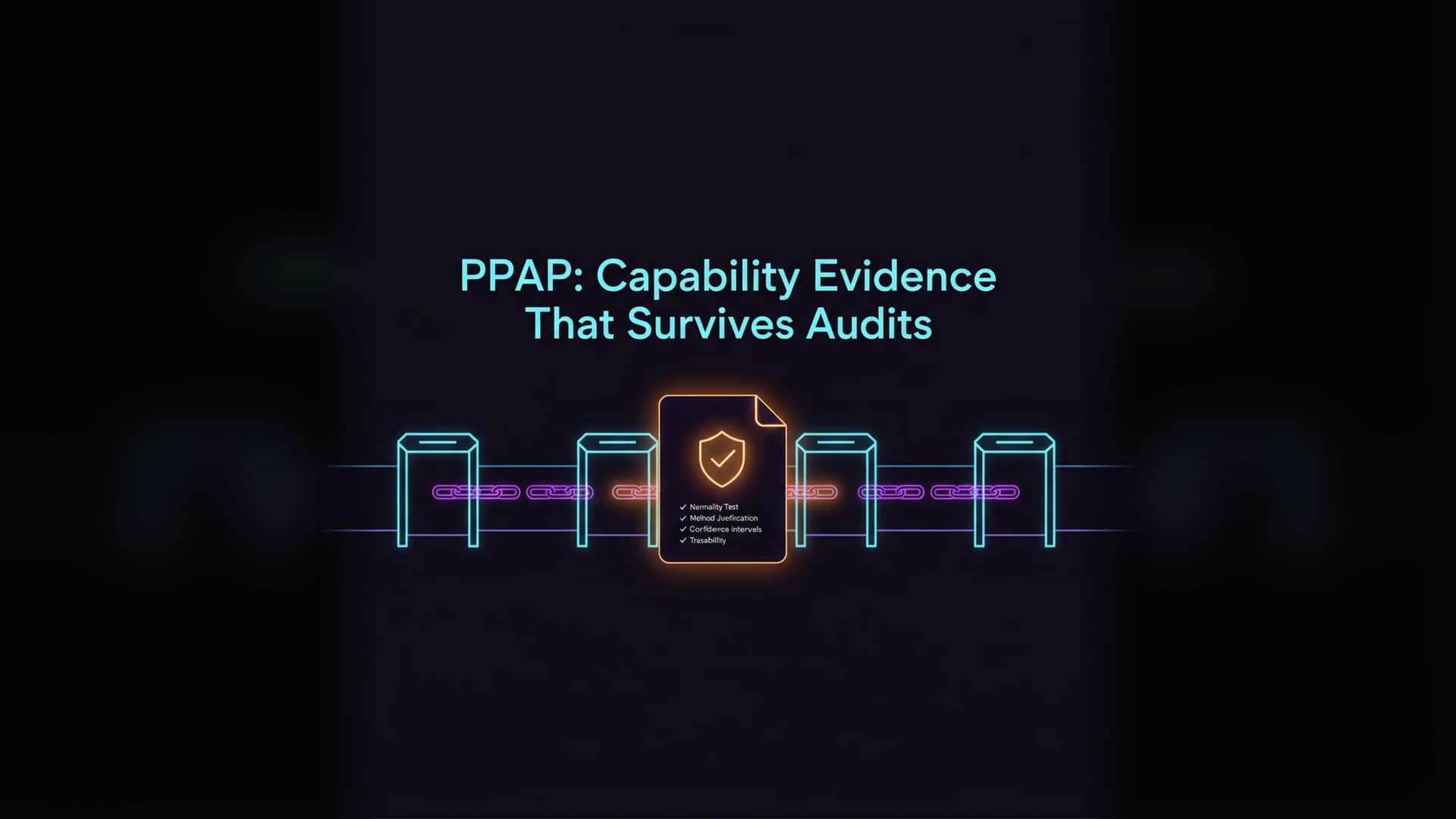
Your PPAP got rejected — not for bad parts, but for bad statistics. OEM auditors now scrutinize whether your Cpk method matches your data. Build a PPAP capability evidence chain that withstands the toughest audits.
Section 8.5.1.1 of IATF 16949 and the AIAG/VDA Statistical Process Control Reference Manual require organizations to demonstrate process capability using "appropriate statistical tools."
That word — "appropriate" — is doing all the heavy lifting. It means: methods that produce correct results for your data. If your data isn't normally distributed, then Cpk = (USL - μ) / 3σ produces incorrect results. Using it isn't appropriate. It's convenient.
Nowhere in IATF 16949. Nowhere in the SPC Manual. Nowhere in the PPAP requirements. Not one clause mandates that capability must be calculated assuming Gaussian data.
How an Entire Industry Got This Wrong
Historical inertia. Shewhart designed SPC methods in the 1920s for normally distributed data because the math was tractable with slide rules. When software vendors built SPC tools in the 1990s, they implemented what the textbooks taught. When training companies built certification courses, they taught what the software did.
By 2026, the normality default is baked into every tool, every course, and every customer requirement. Quality engineers learned "Cpk = (USL - μ) / 3σ" as the formula — not as a formula that requires a specific distributional assumption to be mathematically valid.
Result: an entire industry calculating capability indices that are provably wrong for most of their datasets, because nobody questions the default.
The $200K Mistake Nobody Audits
Two scenarios that happen regularly:
Scenario A: False confidence. Your machining process produces right-skewed dimensions (common near physical stops). Traditional Cpk: 1.45. You submit it in your PPAP package. The auditor accepts it. But the true capability — computed without the normality assumption — is 1.12. Below 1.33. Not capable. Those extra defects show up in your scrap logs six months later.
Scenario B: False alarm. Your skewed data produces traditional Cpk = 0.95. Management approves $200K in process improvements. But entropy-based Cpk was 1.52 all along. The "incapability" was an artifact of forcing a symmetric bell curve onto asymmetric data. You spent six figures fixing a process that was already capable.
Who's responsible? The standard said appropriate methods. You used an inappropriate one. The fact that it's the industry default doesn't change the mathematics.
What the SPC Manual Actually Recommends
Open the AIAG/VDA SPC Manual to the sections on non-normal data. It explicitly states:
Not all process data is normally distributed
When data is non-normal, standard Cpk formulas produce incorrect results
The limitation? Every alternative the manual offers — Johnson transformations, Pearson curves, Clements' method — still requires you to identify or assume a specific distribution. They replace one assumption with another.
Entropy-based methods make no distributional assumption at all. The EGDF learns your data's actual shape. The capability index it produces is correct for whatever distribution your data follows — normal, skewed, bimodal, bounded, or unrecognizable.
That's not just appropriate. It's the most appropriate method available.
Four Steps to Audit-Proof Capability Evidence
Preparing APQP/PPAP capability studies that survive scrutiny:
1. Test your data. Run a normality test (Kolmogorov-Smirnov, Anderson-Darling, Shapiro-Wilk) on every critical characteristic. Document the p-value. If normality is rejected (p < 0.05), you now have documented evidence that normal-based Cpk is inappropriate for this characteristic.
2. Compute both. Report traditional Cpk alongside distribution-free Cpk. When they agree — great, your process is normal for this dimension. When they disagree, the distribution-free number is correct.
3. Document the method. One sentence: "Capability computed using entropy-based distribution-free methods per AIAG/VDA SPC Manual recommendation for non-normal data." Factually accurate. Demonstrates methodological rigor.
4. Show the evidence. Include the distribution plot — EGDF vs. Gaussian overlay — in your submission. A picture of bimodal data next to a bell curve is more convincing than any argument about statistical theory.
The Window Is Open
The AIAG/VDA SPC Manual is in draft review for a new edition (public comment deadline: May 3, 2026). The trend in quality standards is unmistakable: specify the outcome (demonstrated capability), not the technique (normal-based formulas).
Suppliers who adopt distribution-free methods today aren't breaking any standard. They're ahead of the curve. When the next SPC Manual edition explicitly addresses modern statistical methods, early adopters will already have capability evidence that meets updated expectations — while competitors scramble to catch up.
The Takeaway
Your customers want reliable capability evidence. Your auditors want defensible methods. Your process data wants to tell you the truth.
Normal-based Cpk forces all three into a bell curve. The standard you're citing to justify it never asked you to do that. It asked for appropriate methods.
For non-normal data, entropy-based methods aren't a workaround. They're a more faithful implementation of what IATF 16949 actually requires.
See what your capability numbers look like when you drop the normality assumption. Upload your process data and get entropy-based Cpk in under 60 seconds. Analyze your data free →
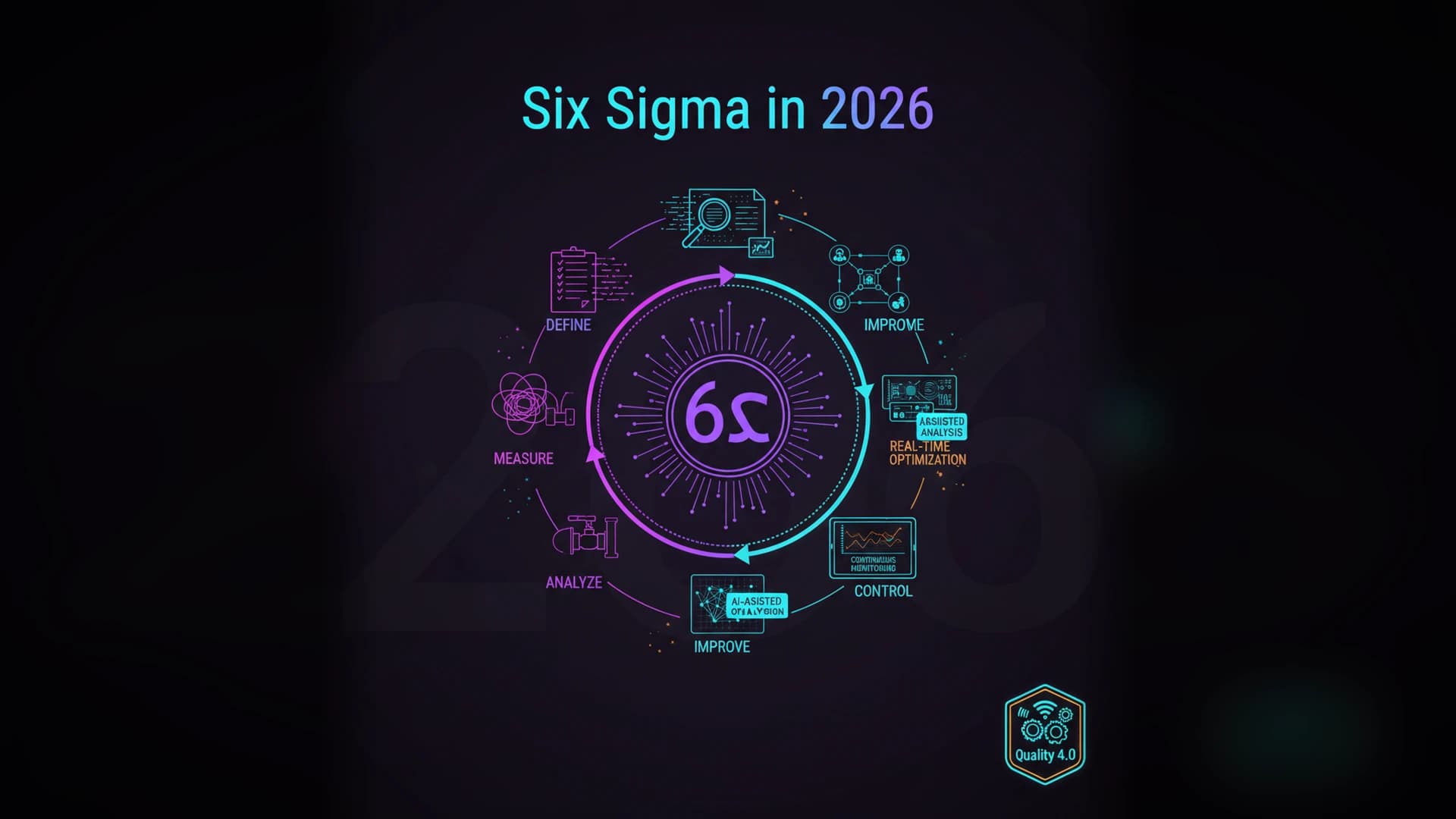
Six Sigma’s core insight — reduce variation to reduce defects — is timeless. But the normality default, manual data collection, and belt-certification gatekeeping need updating. Here’s what modern Six Sigma looks like with distribution-free methods and Quality 4.0.
First pass yield says 98.2%. Cpk says 0.94. One measures what happened. The other predicts what will happen next. When they disagree, something important is hiding — and knowing which to trust prevents costly mistakes.