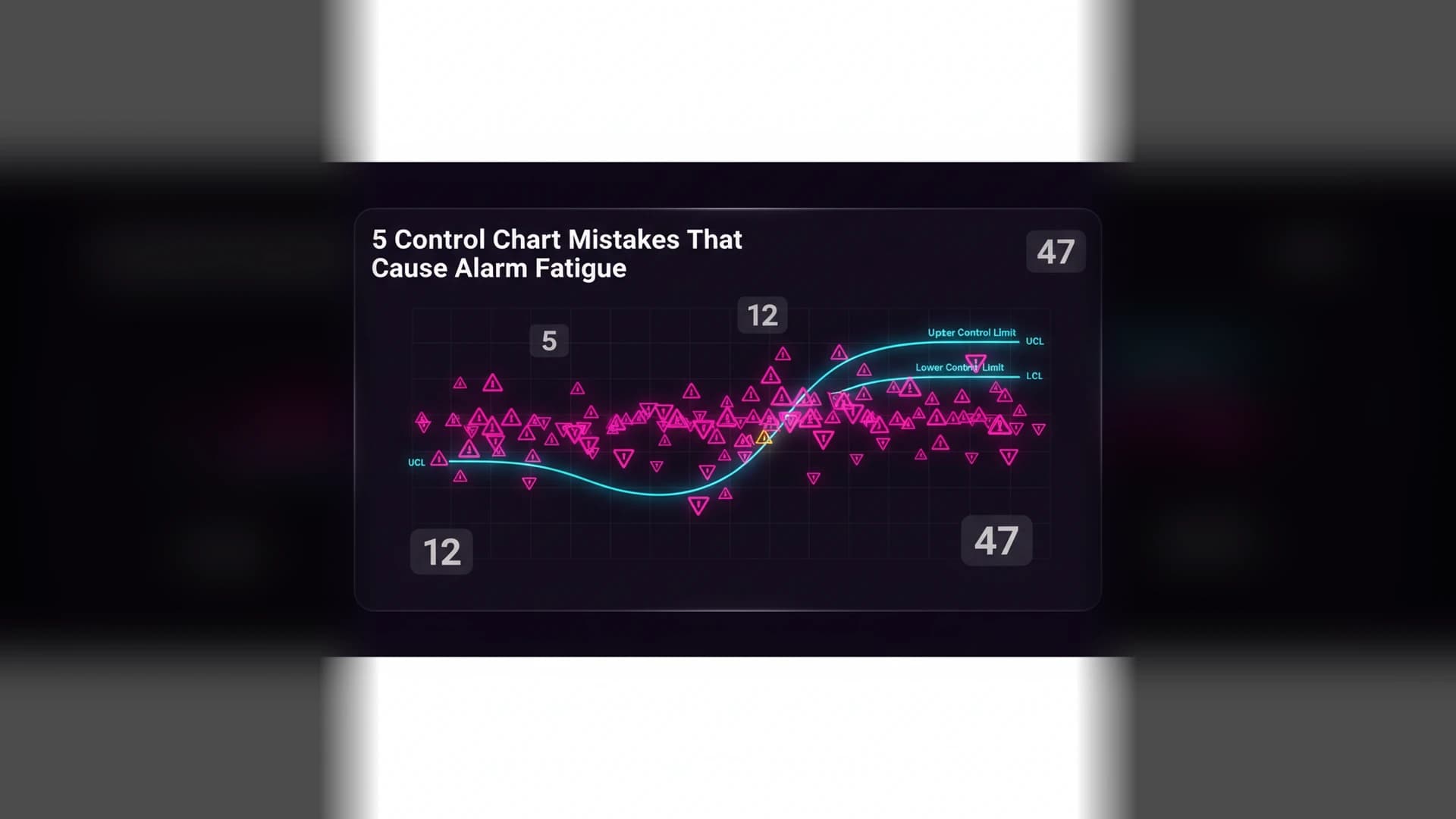
Alarm fatigue is the most dangerous quality problem nobody talks about. Your control charts fire so many false signals that operators learn to ignore them — and then miss the real ones.
How many alarms did your team investigate last month? How many had an assignable cause? If the ratio is "a lot" to "almost none," you don't have a process problem. You have a chart problem. That gap between signals and real causes is quietly destroying trust in SPC.
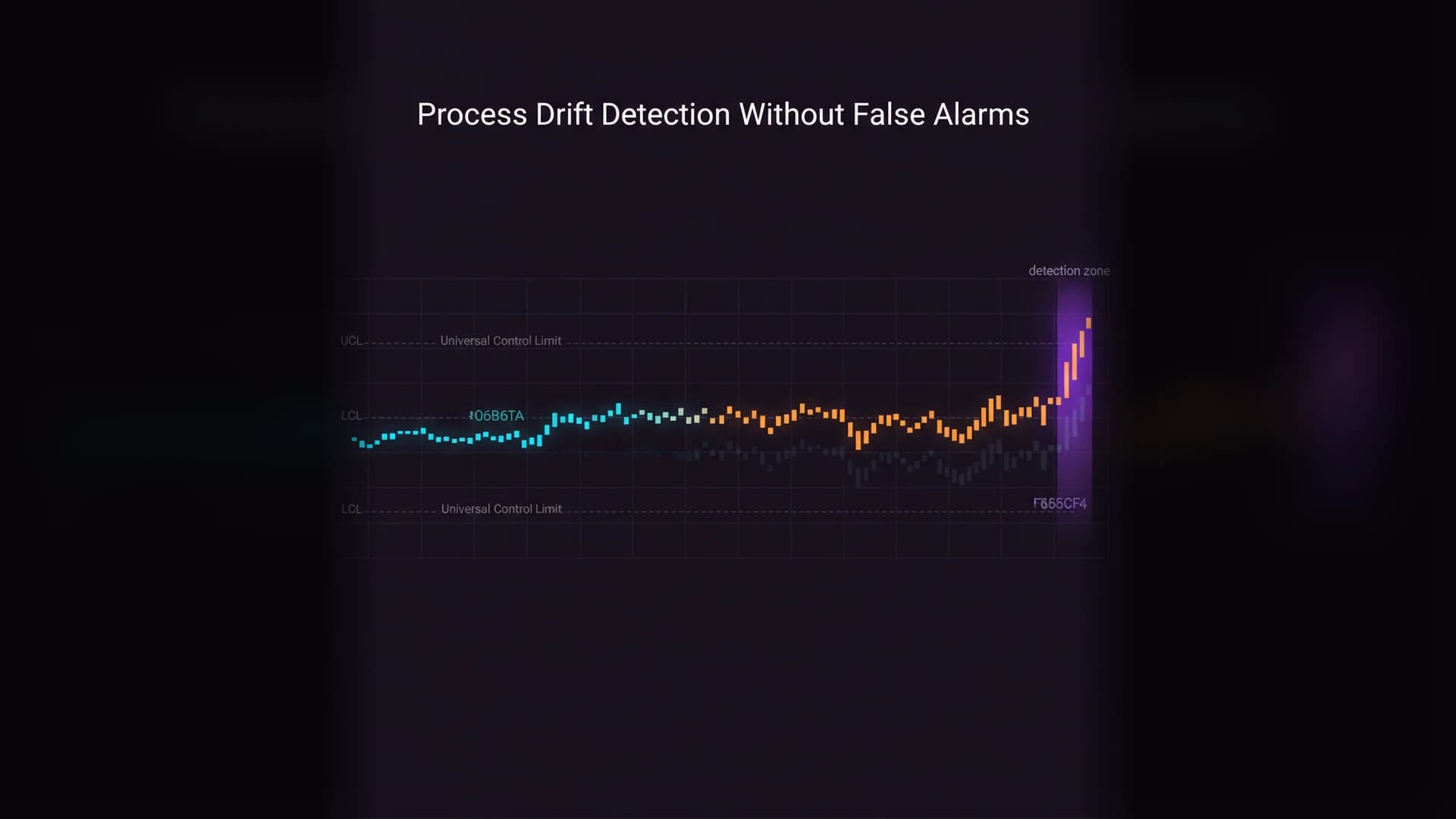
Process drift hides under false alarms. Shewhart charts catch sudden shifts but miss gradual process drift — while Nelson rules fire on stable data. Entropy-based homogeneity testing separates real drift from noise without chart configuration.
Here are five control chart mistakes driving those false signals, and specific fixes for each.
1. Running All 8 Nelson Rules at Once
Shewhart's original chart had one rule: a point beyond 3σ. Clean, well-understood, 0.27% false alarm rate per point.
Then the Nelson rules arrived. Then Western Electric rules. Then "enhanced" rule sets from software vendors. A modern SPC package might apply all eight simultaneously:
1 point beyond 3σ
9 points in a row on one side of center
6 points trending up or down
14 points alternating up-down
2 of 3 points beyond 2σ
4 of 5 points beyond 1σ
15 points in a row within 1σ
8 points in a row beyond 1σ
Each rule's false alarm rate is manageable alone. Apply all eight, and the combined probability that at least one triggers on a perfectly stable process is 2–5% per 20-point window. Over a 100-point shift? You're virtually guaranteed a false signal. Every shift. Every day.
The fix: Pick 2–3 rules matched to failure modes you actually see. Gradual drift? Use trend and run rules. Sudden shifts? Use the 3σ and zone rules. Applying everything is not thoroughness — it's noise.
2. Calculating Limits from Mixed Data
Control limits assume the baseline data came from a single, stable process. If your reference dataset contains a tool change, a lot switch, or a calibration drift — if it's not homogeneous — your limits are wrong from the first plotted point.
Mixed baseline data inflates estimated σ. Wider limits, fewer alarms. Sounds like less fatigue. It's worse.
You now have limits that are simultaneously too wide to catch real shifts and polluted with structural patterns that trigger occasional false signals. The chart is too sensitive and not sensitive enough at the same time. Operators learn: "it alarms, but nothing's ever wrong."
The fix: Verify data homogeneity before calculating limits. If cluster detection or homogeneity testing reveals subpopulations in your baseline, separate them or address the source. Limits from genuinely homogeneous data are tighter, more reliable, and generate fewer false signals.
3. Ignoring Autocorrelation
Shewhart charts assume independence: each measurement unrelated to the last. In continuous processes — chemical reactors, extrusion lines, heat treatment ovens — that assumption fails immediately. The temperature at minute 10 is obviously related to minute 9.
With autocorrelated data, standard control limits become too tight. Every natural fluctuation triggers an alarm because the chart doesn't understand that consecutive points should move together.
These false alarms are especially dangerous because they look real. They match Nelson rules. The values genuinely fluctuate. Engineers investigate, find nothing, investigate again, find nothing, and eventually stop investigating.
Then a real shift happens. Same cursory response. Same "no assignable cause" conclusion. Except this time there was one.
The fix: Test for autocorrelation before setup (lag-1 coefficient > 0.3 is a red flag). For correlated data, use EWMA or CUSUM with appropriate adjustments, or increase sampling intervals until measurements are approximately independent.
4. Investigating Every Signal Like It's a Crisis
Not every out-of-control point is a real process change. Some are false alarms — that's mathematically guaranteed. The question isn't whether false alarms happen. It's whether your response system accounts for them.
Many quality systems mandate investigation and CAPA for every signal. When false alarm rates are high (see Mistakes 1–3), this creates a documentation avalanche. Engineers spend hours writing "investigation complete, no assignable cause found." That's the bureaucratic version of alarm fatigue.
Over time, investigations become checkbox exercises. Nobody actually looks at the process anymore. When a genuine Type I error finally isn't a Type I error — when there's a real shift — it gets the same empty treatment.
The fix: Tiered response. Single point beyond 3σ? Quick visual check. Two consecutive signals or a run-of-nine violation? Formal investigation. One signal from one rule on one chart does not warrant a CAPA.
Track your false alarm rate. If more than 10% of investigations conclude "no assignable cause," your limits or rule set needs recalibration.
5. Keeping Old Limits After Process Improvements
Your team found a real variation source and fixed it. The process is genuinely better. But the control limits still reflect the old, noisier process.
Now the improved process runs well within wide limits. The chart looks perfect — zero alarms. But it's also blind. A process drift that would have been detected with correct limits sails through unnoticed because the old limits accommodate it.
This is the quiet failure. No alarm fatigue — no alarms period. The chart shows "in control" while defects creep up. By the time the problem surfaces as customer complaints or scrap spikes, the chart has been useless for weeks.
The fix: Recalculate limits after every confirmed process change. Including improvements. Tighter limits on a better process maintain detection capability for the smaller shifts that matter now.
Some quality systems resist limit recalculation because it triggers re-validation paperwork. That's false economy. Limits that don't match the current process monitoring state are worse than no limits — they provide false assurance.
Why These Mistakes Create Alarm Fatigue
Every mistake here traces back to the same root: applying control chart methodology without verifying the assumptions it depends on.
Nelson rules assume independent, normally distributed data (Mistakes 1, 3)
Control limits assume homogeneous baselines (Mistake 2)
Investigation protocols assume meaningful signal rates (Mistake 4)
Limit validity assumes current process parameters (Mistake 5)
The solution isn't abandoning control charts. It's verifying assumptions before trusting outputs. Test for normality. Test for homogeneity. Test for autocorrelation. Match your rule set to your actual failure modes.
Or use methods that don't need these assumptions at all. Entropy-based process stability analysis separates real shifts from noise without requiring normality or independence — because it works from the data's actual distribution, not a parametric model.
Your Operators Aren't the Problem
Alarm fatigue doesn't mean your team is careless. It means your charts are crying wolf. Fix these five mistakes and something changes: when a chart signals, someone investigates. When someone investigates, they find something real. When they find something real, the system works.
That's what SPC was supposed to do all along.
See how entropy-based homogeneity testing distinguishes real process shifts from statistical noise — no control chart configuration needed. Analyze your data free →